The Federal High Court sitting in Enugu has upheld the Enugu State Structures for Signage and Advertisement Agency’s (ENSSAA) authority to impose a N150 million political campaign billboard fee. The ruling dismisses a challenge by opposition parties and political figures seeking to stop the agency from enforcing the charge ahead of the 2027 general elections.
A certified true copy of the judgment shows that Justice Mabel Segun-Bello delivered the ruling on September 1, 2026. The court held that outdoor advertising does not fall exclusively under the legislative powers of the National Assembly or the Advertising Regulatory Council of Nigeria (ARCON).
The judgment comes amid debate over Enugu State’s regulation of political campaign materials. ENSSAA had earlier warned residents about its restrictions on outdoor advertising, as reported in the agency’s warning over the poster ban.
Court Upholds ENSSAA’s Authority to Charge N150 Million
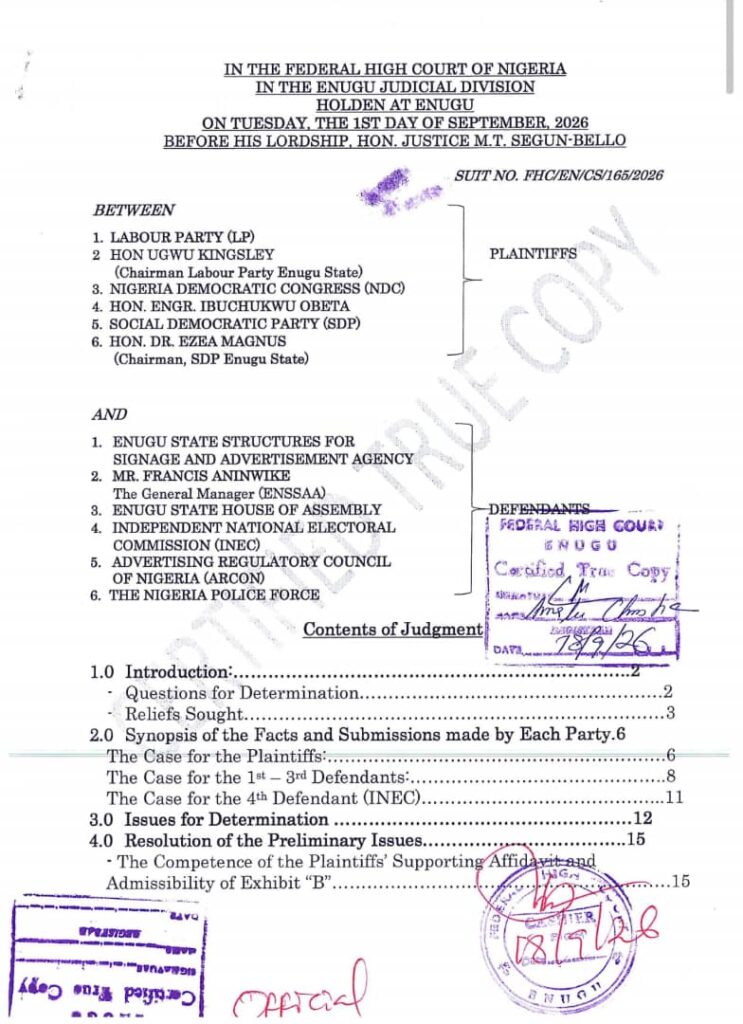
The case, filed as FHC/EN/CS/165/2026, challenged ENSSAA’s authority to impose a mandatory N150 million advertising permit fee. The plaintiffs argued that federal electoral laws gave the Independent National Electoral Commission (INEC) exclusive powers to regulate political campaigns.
The plaintiffs included the Labour Party, its Enugu State Chairman, Kingsley Ugwu, the Nigeria Democratic Congress (NDC), and its factional state chairman, Ibuchukwu Obetta. The Social Democratic Party (SDP) and its state chairman, Magnus Ezea, also joined the suit.
The defendants included ENSSAA, its General Manager, Francis Aninwike, the Enugu State House of Assembly, INEC, ARCON and the Nigeria Police Force. The plaintiffs filed the suit in June 2026, seeking to overturn the fee and prevent its enforcement.
However, Justice Segun-Bello rejected their central argument that outdoor advertising fell exclusively within federal legislative authority. She held that the subject fell within the primary functions of local government, which a state agency could exercise through valid delegation.
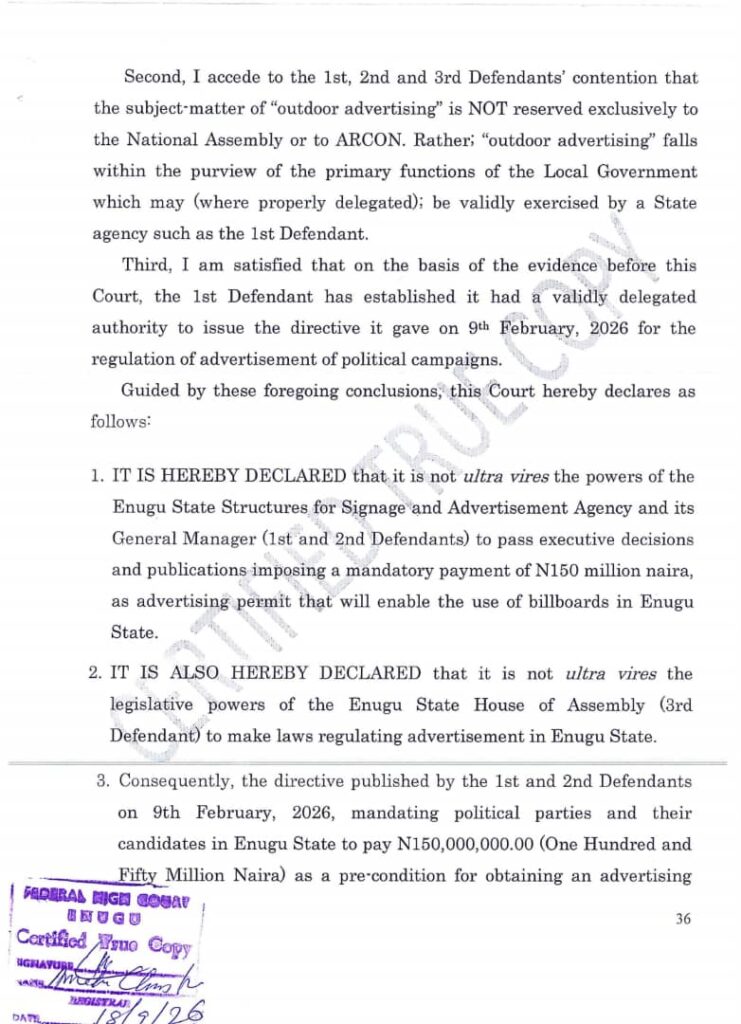
The judge also found that ENSSAA had established its authority to issue the directive dated February 9, 2026. She consequently ruled that the agency’s decision to impose the fee did not exceed its powers.
The dispute has emerged as political parties prepare for upcoming elections. Enugu’s recent political activities have included a peace accord signed by seven parties ahead of the local government polls and assurances from security agencies about a peaceful election.
Judge Says Outdoor Advertising Is Not an Exclusive Federal Matter
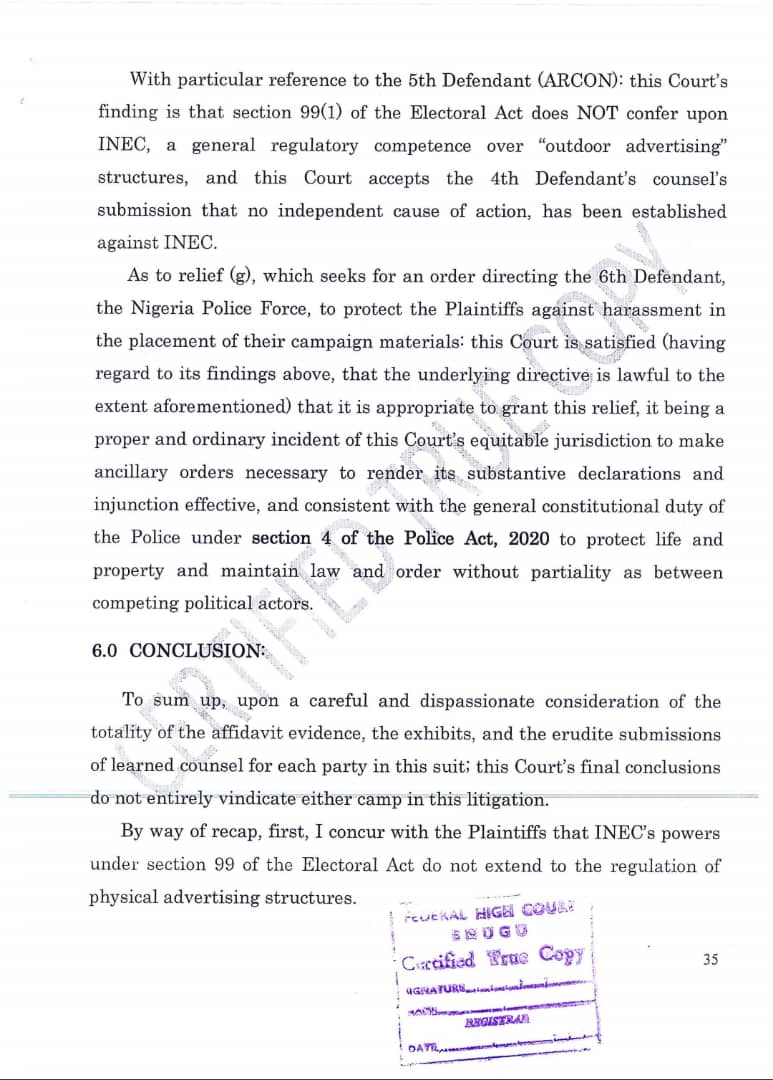
In her ruling, Justice Segun-Bello agreed with the first three defendants that outdoor advertising was not reserved exclusively for the National Assembly or ARCON.
She stated that local governments held primary responsibility for the subject, subject to lawful delegation of their powers. The judge found that ENSSAA had demonstrated such delegated authority in issuing its February directive.
The court therefore declared that ENSSAA and its general manager could lawfully issue decisions and publications requiring payment of N150 million for advertising permits covering political billboards in Enugu State.
Justice Segun-Bello also held that the Enugu State House of Assembly had the legislative authority to make laws regulating advertising within the state. She rejected the plaintiffs’ argument that the law violated the constitutional division of powers.
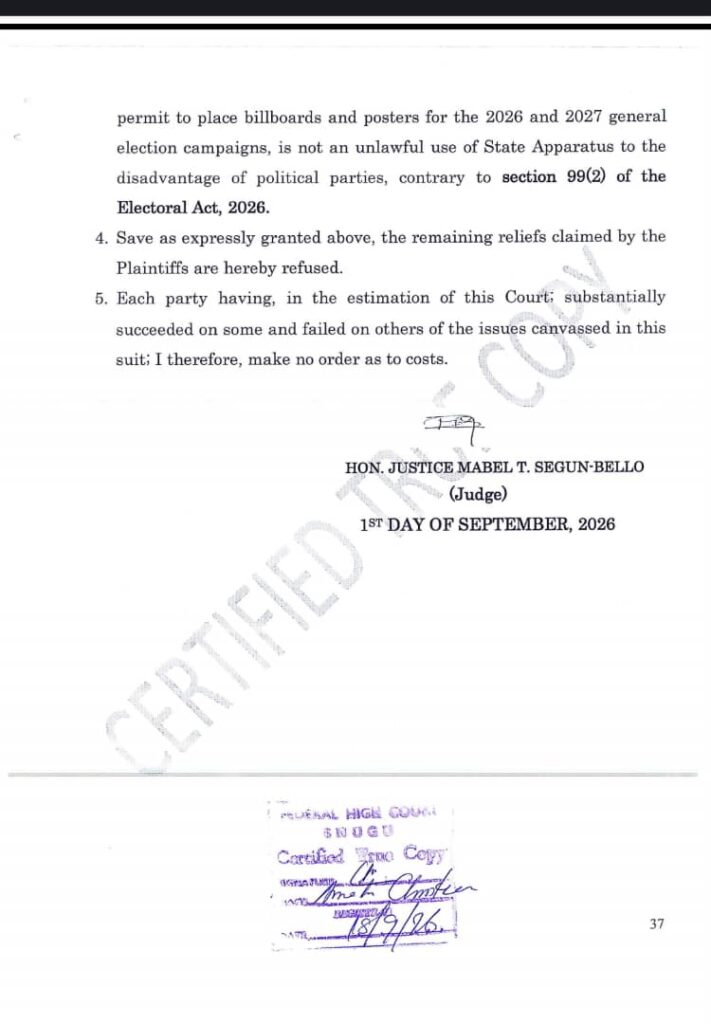
The judge further ruled that the directive did not constitute an unlawful use of state authority against political parties under Section 99(2) of the Electoral Act, 2026. She refused the plaintiffs’ remaining reliefs, except those expressly granted in the judgment.
The decision comes as political parties continue organising across Enugu State. The APC, for instance, secured all contested seats in the recent Enugu local government election.
Other campaign activities have included support rallies in Nara, declarations of support from Ohuani Idodo and Oruku stakeholders, and endorsements from Ihuokpara, Isienu and Akpawfu wards.
Enugu Government Clarifies Who Must Pay the Fee
The Enugu State Government has also addressed confusion surrounding the N150 million charge. Secretary to the State Government, Professor Chidiebere Onyia, said the fee applies to each political party rather than individual candidates.
Onyia made the clarification while answering questions from Government House correspondents in Enugu. He also dismissed social media reports claiming that a Federal High Court sitting in Abuja had nullified the fee.
According to the government, the judgment supporting ENSSAA’s authority came from the Federal High Court in Enugu. The certified true copy cited in the announcement records the September 1 ruling by Justice Segun-Bello.
The clarification is significant because the charge has generated public discussion about political parties’ access to campaign advertising. The government maintains that some reports have misrepresented both the location of the court ruling and the party-based nature of the fee.
The court’s ruling does not mean every claim circulating online accurately describes the judgment. Readers should distinguish the court’s actual findings from political commentary and social media interpretations.
Political activity across the state has also generated coverage of party mobilisation in Ugbakwa wards and Nkerefi. These developments illustrate the wider campaign environment in which the advertising rules will operate.
Other States Also Charge Political Advertising Fees
The report also compares political advertising charges in other states. According to the information provided, the Abia State Structures for Signage and Advertising Agency (ABSSAA) has prescribed fees ranging from N20 million for State House of Assembly candidates to N200 million for presidential candidates.
In Imo State, the reported charges range from N3.55 million for House of Representatives candidates to N55 million for governorship candidates. The source also lists permit fees ranging from N300,000 for local council candidates to N150 million for presidential candidates.
The report gives another fee range of N100,000 for councillorship candidates to N50 million for presidential candidates, although it does not clearly identify the state to which that schedule applies. It also states that Kwara State charges N2 million for each House of Assembly candidate and N100 million for presidential candidates.
These comparisons suggest that political advertising permit fees vary considerably across jurisdictions. However, the schedules should be checked against official state agency publications before making direct comparisons.
Enugu’s wider development agenda has also featured in reports on Governor Peter Mbah’s achievements and the state government’s efforts to sustain development gains. Meanwhile, NACCIMA has praised the state’s security record and economic ambitions.
Other state initiatives include community sensitisation across six Enugu communities and the South-East agro-development programme launched in Enugu. The region’s economic discussions have also included opportunities linked to the SEDC agro-mechanisation project.
ENSSAA Billboard Fee Remains in Force Following Ruling
The September 1 judgment supports ENSSAA’s authority to regulate outdoor advertising and enforce the N150 million political campaign billboard permit fee. The court rejected the plaintiffs’ central challenge to the agency’s powers and the state legislature’s authority to regulate advertising.
The Enugu State Government has separately clarified that the charge applies to each political party, not every individual candidate. The ruling and clarification are likely to remain central to discussions about campaign advertising as political parties prepare for the 2027 general elections.