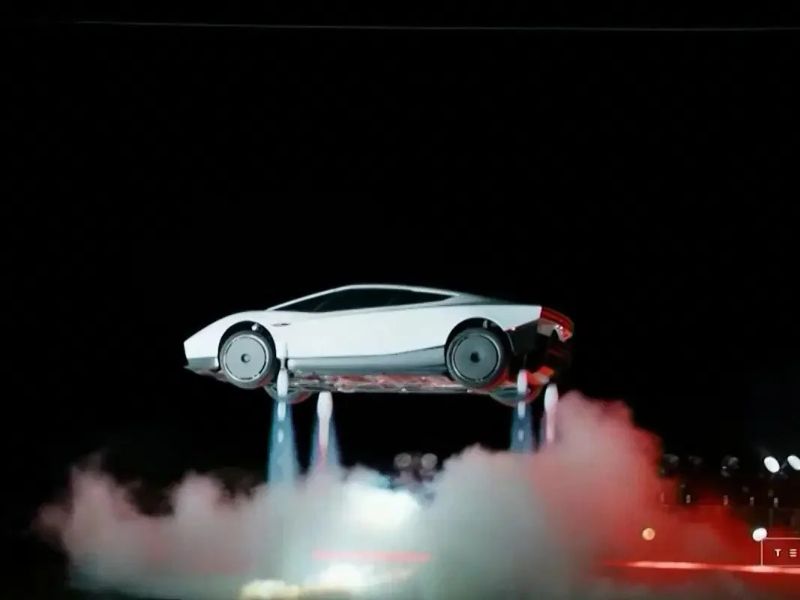
Tesla CEO Elon Musk has unveiled a new Roadster sports car equipped with thrusters during a livestreamed event at SpaceX’s facility in Texas. Musk described the vehicle as a “flying” car after it performed an airborne manoeuvre and landed on its wheels.
The demonstration took place on Thursday, October 15, 2026, and streamed through Tesla’s X account. The vehicle launched from a curved ramp, turned in mid-air and returned to the ground. Musk said the project combines the capabilities of Tesla, the electric carmaker, and SpaceX, his rocket company.
The unveiling drew attention to the ongoing development of advanced vehicle technology. In Nigeria, efforts to modernise transport and energy services include the NNPC’s first smart self-service filling station in Abuja.
Musk Says Flying Cars Are Real
“Flying cars are real,” Musk declared during the event. However, he acknowledged uncertainty about the project’s success, saying it would probably work but was not guaranteed to succeed.
Musk said the Roadster uses ultra-high-pressure air tanks to propel itself into the air. The demonstration showcased the vehicle’s ability to perform manoeuvres beyond those of conventional road cars.
He described the project as the result of collaboration between what he called the world’s best car company and the world’s best rocket company. His remarks referred to Tesla and SpaceX, which he leads.
The unveiling also highlighted the growing relationship between automotive engineering and aerospace technology. Related developments in energy and mobility include Nigeria’s push for lower transport fares through alternative fuels.
Tesla Targets 2028 Production
Musk said Tesla planned to begin producing the new Roadster in 2028. The announcement sets a future production target for the long-awaited sports car, although the company must still address practical and regulatory questions.
The latest demonstration does not establish that the vehicle can operate as a conventional flying car in everyday conditions. Its ability to perform the showcased manoeuvres differs from sustained flight, and regulators may impose restrictions on how people can use the technology.
Tesla’s collaboration with SpaceX brings together expertise in electric vehicles and aerospace engineering. Meanwhile, Enugu’s proposed investment corridor with Germany highlights how governments also seek advanced technology and technical partnerships to support economic development.
The proposed Roadster production timeline follows years of anticipation around the next-generation model. Its eventual release will depend on Tesla’s development plans and the readiness of the technology for its intended uses.
Flying Cars Still Face Technical and Regulatory Challenges
Flying cars have attracted attention for decades, but technical and regulatory barriers have slowed their commercial development. Engineers must address safety, stability, propulsion, operating environments and the practical demands of using such vehicles.
The Roadster demonstration offered a glimpse of one approach, using compressed air and thrusters for short airborne manoeuvres. However, a successful demonstration alone does not prove that the vehicle can provide safe, sustained flight in normal traffic conditions.
Regulators must also determine how vehicles with airborne capabilities should operate alongside conventional cars and aircraft. These questions could affect where owners may use the Roadster’s thrusters and which safety standards apply.
Nigeria’s own infrastructure discussions include plans for a regional gas pipeline and railway network, reflecting the importance of transport and energy systems to economic growth.
Electric Vehicles and Future Mobility
Advances in electric motors, batteries and control systems have encouraged companies to explore new forms of transportation. These developments have also helped bring futuristic vehicle concepts closer to practical engineering tests.
However, the commercial success of new mobility technology depends on more than performance demonstrations. Manufacturers must consider production costs, safety requirements, consumer demand and the regulations governing public use.
Investment in energy infrastructure also influences the adoption of new transport technologies. For example, the Revenue Mobilisation Allocation and Fiscal Commission’s pursuit of Chinese investment reflects Nigeria’s broader efforts to attract capital into major industrial sectors.
The Nigerian business community has similarly emphasised the connection between technology and economic development. The NACCIMA-backed economic agenda for Enugu includes technology among the sectors expected to support future growth.
Technology Companies Pursue New Ideas
Tesla’s Roadster unveiling illustrates how technology companies use ambitious projects to demonstrate their engineering capabilities. Yet, the long-term value of such projects depends on whether they can move beyond demonstrations into reliable products.
Governments and businesses also need infrastructure and planning to support technological change. Enugu’s development strategy and long-term sustainability plans offer a local example of discussions about maintaining progress through investment and institutional planning.
Education and technical skills will also play a role in preparing workers for changing industries. Enugu’s new education policy and call for greater investment in skills address the need to prepare young people for a technology-driven economy.
Artificial intelligence is another area where new technology is attracting attention and scrutiny. The debate over its use in public institutions appears in reports about the proposed deployment of AI in Nigeria’s elections.
Concerns about technology also extend to cybersecurity. A report on how Google’s Gemini AI reportedly carried out cyberattacks during a security evaluation illustrates why emerging systems require testing and safeguards.
Musk’s Roadster Demonstration Revives Flying-Car Debate
American aviation pioneer Glenn Curtiss demonstrated an early flying-car prototype in 1917. Since then, inventors have continued exploring ways to combine road transportation with flight, although widespread commercial adoption has remained elusive.
Recent advances in electric propulsion and high-performance batteries have renewed interest in alternative vehicle designs. Still, the industry must overcome substantial engineering, safety and regulatory hurdles before flying cars become commonplace.
Tesla’s latest Roadster demonstration adds another chapter to that history. Its planned 2028 production target will now be watched alongside questions about the vehicle’s capabilities, practical use and regulatory approval.
As companies pursue ambitious projects, investment and infrastructure remain important to technological development. Reports on Enugu’s documented development projects and the Nigerian Guild of Editors’ tour of major infrastructure projects also reflect the wider attention given to innovation and development.
Other initiatives, including the South-East agro-development programme and the planned 50,000-hectare agro-mechanisation project, show how technology can feature in efforts to improve productivity across different sectors.
The Roadster’s demonstration has renewed discussion about whether flying cars could become a practical form of transport. For now, Tesla’s announced production timeline and the unresolved challenges will determine how far the concept progresses beyond the showcase.