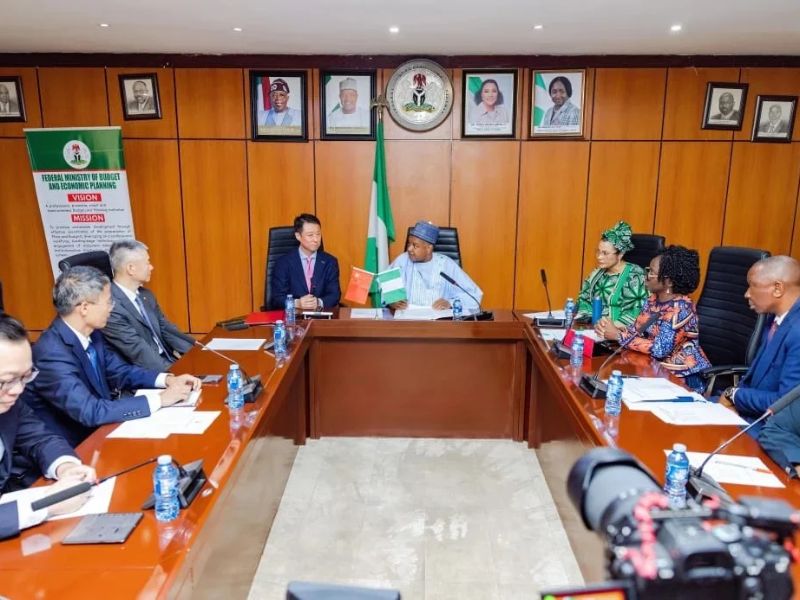
The Federal Government has signed a $30m grant agreement with China to finance community-based development projects across Nigeria. The initiative aims to reduce poverty, improve livelihoods and expand economic opportunities at the grassroots.
The agreement, valued at RMB200m, was signed on Thursday at the Federal Ministry of Budget and Economic Planning in Abuja. The ministry disclosed this in a statement issued on Sunday.
The ministry stated, “Nigeria and China have signed a grant agreement worth RMB200m (approximately $30m) to support community-focused development projects under the Nigeria–China Development Cooperation, reinforcing the two countries’ longstanding strategic partnership.”
The grant will finance mutually agreed projects under China’s “small but beautiful” initiative. The programme prioritises relatively small-scale interventions designed to deliver direct benefits to local communities.
China Grant Targets Community Development
Speaking at the signing ceremony, the Minister of Budget and Economic Planning, Abubakar Bagudu, said the partnership would “support Nigeria’s development priorities through targeted investments, knowledge exchange and institutional cooperation.”
He explained that the ministry was “working with the Nigeria–China Strategic Partnership Office to develop projects proposed by state governments to address specific community needs.”
Bagudu stressed that the priority was to ensure bilateral agreements produced measurable improvements in people’s living conditions rather than remaining diplomatic commitments.
The minister’s remarks align with ongoing efforts to strengthen community participation in development projects. In Enugu State, for instance, the Community and Social Development Agency has stressed the importance of responsible leadership and community participation in grassroots projects.
The agency has also identified additional communities for development interventions under the NG-CARES 2.0 programme, as reported in its latest community development engagement.
Renewed Hope Ward Development Plan
Bagudu also highlighted the Federal Government’s Renewed Hope Ward Development Plan, which seeks to identify economic opportunities and economically active residents across Nigeria’s 8,809 wards.
According to him, the initiative would support targeted development interventions, particularly in underserved communities. It would also provide opportunities to draw lessons from China’s experience in poverty reduction.
The ward development plan forms part of broader efforts to improve living conditions and expand economic opportunities across the country.
The Federal Government has also pursued other initiatives aimed at supporting vulnerable Nigerians. Enugu State Governor Peter Mbah recently backed the removal of fuel subsidy, saying the government could direct resources towards targeted support for vulnerable citizens.
Nigeria, China Deepen Development Cooperation
The latest grant follows an earlier $1m contribution from China in 2026 to strengthen Nigeria’s technological and knowledge development capacity.
Bagudu also identified the training of Nigerian officials in China as an important component of bilateral cooperation. He said capacity building would improve the country’s ability to implement development programmes.
Speaking at the ceremony, the Chinese Ambassador to Nigeria, Yu Dunhai, described the agreement as a “demonstration of China’s commitment to supporting Nigeria’s economic and social development.”
He said the grant followed agreements reached between Presidents Bola Tinubu and Xi Jinping during their meeting in China and subsequent bilateral engagements.
The agreement comes amid growing economic relations between both countries. China’s ambassador recently urged Nigeria to sustain its economic reforms, highlighting growing trade and investment opportunities between Nigeria and China.
The Revenue Mobilisation Allocation and Fiscal Commission has also sought to attract Chinese investment into Nigeria’s oil and gas sector, as part of efforts to boost revenue and expand investment.
China-Nigeria Trade Reaches $18bn
Dunhai disclosed that trade between Nigeria and China reached $18bn in the first half of 2026, while Nigerian exports to China increased by 80 per cent.
He attributed emerging trade opportunities partly to China’s zero-tariff policy on Nigerian exports, which took effect on May 1, 2026.
The ambassador said the arrangement could improve market access for Nigerian products, attract investment and encourage domestic processing and industrial development.
However, he warned that the current zero-tariff arrangement was scheduled to expire on May 1, 2028. He urged both countries to pursue a longer-term economic development partnership agreement.
He called on the Ministry of Budget and Economic Planning and the Federal Ministry of Industry, Trade and Investment to advance discussions on the proposed framework.
Nigeria has also continued to pursue foreign investment in infrastructure and industrial development. The Federal Government recently commenced a South-East gas pipeline project aimed at boosting industrialisation, attracting investment and creating jobs.
The South-East Development Commission has also outlined plans for a major agro-mechanisation project to improve farming and create jobs.
Ministry Pledges Transparent Implementation
The Permanent Secretary of the Ministry of Budget and Economic Planning, Deborah Odoh, welcomed the grant and commended the institutions involved in concluding the agreement.
The ministry pledged to work with Chinese authorities and relevant Nigerian institutions to ensure transparent and efficient implementation of the projects.
The agreement comes as Nigeria and China mark 55 years of diplomatic relations in 2026. Both countries are seeking to deepen cooperation in trade, investment and grassroots development.
The grant is expected to support community-focused projects that address local needs and improve livelihoods. Its impact will depend on how effectively the projects are selected, implemented and monitored.
Nigeria has also continued to seek external financing for development projects. President Tinubu recently asked the National Assembly to approve additional external loans to support infrastructure and development across critical sectors.
The government has said such financing would help address infrastructure gaps and support economic growth.
Meanwhile, development agencies continue to emphasise community involvement in identifying and implementing projects. Enugu’s CSDA has taken its community sensitisation and rural appraisal exercise to more communities, as detailed in its report on grassroots development under NG-CARES.
The China grant adds to Nigeria’s efforts to attract development support and strengthen international partnerships. Both governments have expressed commitment to ensuring that cooperation delivers practical benefits for communities and the wider economy.