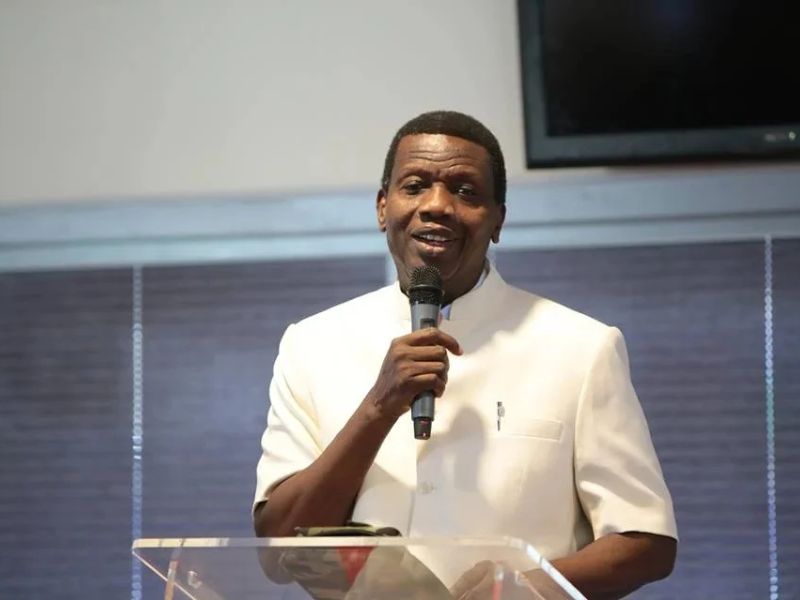
The General Overseer of the Redeemed Christian Church of God, Pastor Enoch Adeboye, has accused journalists of misrepresenting the date and purpose of a prayer walk he led in Lagos.
Adeboye said reports falsely linked the exercise to former President Goodluck Jonathan’s administration, even though it took place in 2020, five years after Jonathan left office.
The cleric said the walk was organised to pray against insecurity and killings in Nigeria. He spoke during the church’s November Thanksgiving service on Sunday.
Adeboye recounted how a report portrayed him as a wicked man for carrying a placard allegedly against Jonathan. He said the report gained widespread acceptance without journalists verifying the circumstances surrounding the incident.
“Recently, just one mischievous somebody wrote in the papers, or said somehow, ‘Pastor Adeboye is a very wicked man. After all, we know that not too long ago, he carried a placard against President Goodluck Jonathan,’” he said.
Adeboye says prayer walk was not a protest
Adeboye said he initially smiled when he learnt about the report. He acknowledged carrying a placard but stressed that the event was a prayer walk, not a protest against Jonathan.
“True, I carried a placard. I can’t deny that. It was important. It was a prayer walk. We wanted to pray,” he said.
He explained that the exercise followed a directive for churches to organise prayer walks around their premises.
“The chairman said all churches should do a prayer walk near their churches. That’s what I did,” he said.
The cleric said the date of the incident alone contradicted the claim that he had carried the placard against Jonathan while he was president.
“But I carried the placard in 2020. Jonathan ceased to be president in 2015. I carried the placard five years in the second term of Buhari,” Adeboye said.
Jonathan left office in May 2015 and was succeeded by former President Muhammadu Buhari. Adeboye maintained that the 2020 exercise took place during Buhari’s administration and had no connection to a protest against Jonathan.
He accused the journalist of twisting the facts and criticised the failure to investigate the circumstances before publishing the report.
“But a journalist twisted it. I said, I did what I did in 2015. And everybody swallowed it,” he said.
Cleric calls for investigative journalism
Adeboye also recalled his exposure to journalism studies in the 1960s. He said he learnt about investigative journalism and the need to verify information before publication.
“I remember in those days in the Department of Journalism, when you go there and you take a course, they talked about something called investigative journalism,” he said.
He added: “That things don’t appear as they may seem. Investigate, if you have a story, before you take it to the press.”
Addressing members of the creative industry, Adeboye expressed disappointment that the report had been accepted without proper checks.
“I’m talking to those of you in the creative industry. Nobody checked,” he said.
His comments centred on the need to establish the date, purpose and circumstances of an event before drawing conclusions about it. He said the report did not reflect the context of the prayer walk.
Prayer walk took place in Lagos in 2020
On February 2, 2020, Adeboye led members of the RCCG on a prayer walk in Lagos to express concern over killings and insecurity across Nigeria.
The exercise followed a three-day fasting and prayer programme declared by the Christian Association of Nigeria. The programme sought divine intervention and stronger efforts to tackle terrorism and other security challenges.
According to reports published at the time, the procession began at the RCCG’s national headquarters in Ebute Meta, Lagos. It proceeded towards Atan Cemetery in Yaba before returning to the church.
Photographs from the event showed Adeboye carrying a placard bearing the inscription, “All Souls Are Precious to God.”
The walk took place during Buhari’s administration. The photograph later circulated on social media alongside claims that Adeboye had protested against Jonathan’s government.
Adeboye’s account disputes that claim. He said the placard was part of a prayer exercise focused on insecurity, rather than a political demonstration against a former president.
Insecurity remains a major concern
The controversy has renewed attention on the importance of verifying information before publication, particularly when reports involve public figures and sensitive political issues.
Nigeria continues to face security challenges, with communities and religious organisations frequently calling for stronger action to protect lives and property. Recent reports have also highlighted concerns about insecurity, including NOSCEF’s warning that Nigerians cannot enjoy true independence while living in fear.
The Federal Government has also announced measures aimed at improving security. President Bola Tinubu recently said new Army formations would strengthen the military’s response to insecurity.
Lawmakers have called for urgent action to protect vulnerable communities, including the rescue of 116 abducted schoolchildren in Borno.
Other security-related developments have included the rescue of kidnapped victims by troops in Sokoto.
The debate surrounding Adeboye’s prayer walk also highlights the role of journalism in ensuring public discussions are based on accurate information. Journalists must verify claims, dates and circumstances, and provide readers with the context needed to understand an event.
The issue is especially important when photographs or statements circulate without details about their original publication. An image may show what happened, but the date and surrounding circumstances help establish what the event meant.
Adeboye maintained that his 2020 prayer walk was intended to seek divine intervention over insecurity and killings. He rejected the claim that he carried the placard to protest against Jonathan’s government.