
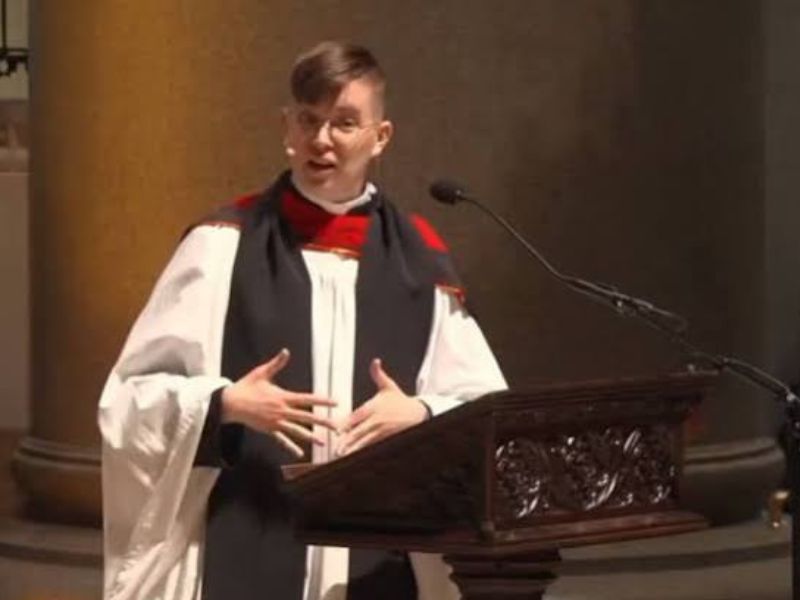
An Episcopal priest has offered a controversial interpretation of Jesus’ resurrection, describing it as a form of gender transition. The Rev. Flourish Klink made the remarks during a service at New York City’s Cathedral Church of St. John the Divine.
Klink spoke at the cathedral’s “Celebration of Trans Joy and Resilience.” The noonday prayer service was organised in partnership with the Episcopal Diocese of New York.
In a sermon published by Klink, the priest described God as existing beyond conventional categories of male and female. Klink therefore characterised God as “non-binary” and, more specifically, “trans.”
Priest Describes God as Beyond Male and Female
Klink argued that human understandings of gender do not fully encompass God’s nature. The priest used this interpretation to discuss Jesus’ birth and resurrection.
According to the sermon, Mary saw the newborn Jesus and identified him as a boy. Klink then argued that this identification assigned Jesus a gender that did not reflect his “true” identity.
The priest’s interpretation connects the discussion of Jesus’ identity with contemporary understandings of transgender identity. It was presented as a theological reflection rather than a direct statement from the biblical accounts.
Readers can explore other stories on religious and cultural discussions.
Klink Points to Jesus’ Life and Interactions
Klink also referred to Jesus’ unmarried status and his interactions with women. The priest described these details as examples of behaviour that differed from expectations for a first-century Jewish man.
The sermon used those observations to support Klink’s interpretation of Jesus’ identity. However, the claims represent the priest’s theological reading of the Gospel narratives.
For more cultural coverage, see stories highlighting traditions and community life.
Sermon Focuses on Jesus’ Resurrection
Klink placed particular emphasis on biblical accounts of Jesus appearing to his followers after the resurrection. Those accounts describe occasions when some disciples initially failed to recognise him.
The priest acknowledged that Scripture does not explain why the disciples sometimes struggled to recognise the risen Jesus. Klink then offered a personal interpretation of those passages.
“I think Jesus was not only transfigured,” Klink said. “I think Jesus transitioned.”
Klink’s statement presents the resurrection as more than a physical transformation. The priest interpreted it as Jesus becoming his “true self,” understood as existing beyond male and female categories.
Priest Presents Interpretation as Message of Hope
Klink connected the interpretation to the experiences of transgender people. The priest argued that Christians could understand human transition as reflecting God’s own nature.
The sermon therefore framed the discussion as a message of hope and affirmation for transgender people. Klink’s remarks have nevertheless prompted criticism from people who disagree with this theological approach.
Related coverage includes stories about public debates and differing viewpoints.
Critics Question the Theological Interpretation
Critics have characterised Klink’s interpretation as heretical or incompatible with orthodox Christianity. Their objections concern the sermon’s description of God and its application of transgender concepts to Jesus.
The criticism reflects disagreement over how Christians should interpret biblical accounts of Jesus’ birth and resurrection. Klink, meanwhile, presented the interpretation as a theological perspective intended to offer hope to transgender people.
The sermon has drawn attention to differing views within Christianity about gender, scripture and theological interpretation. The remarks do not represent a universally accepted Christian understanding of Jesus’ resurrection.
Readers can also find more coverage of public figures and their statements.
Debate Centres on Scripture and Gender
Klink’s sermon links the resurrection narratives with contemporary discussions about gender identity. The priest’s interpretation centres on the idea that Jesus’ resurrected identity went beyond conventional male and female categories.
Critics reject that interpretation as inconsistent with orthodox Christian teaching. The disagreement highlights differing approaches to scripture and the relationship between Christian theology and modern understandings of gender.
Other reports on social and cultural issues are available through community and cultural coverage.