The National Agency for Food and Drug Administration and Control (NAFDAC) has uncovered a suspected counterfeit drinks facility in Lagos State. The operation led to the arrest of two suspects allegedly involved in repackaging alcoholic and energy drinks.
The agency discovered the facility at Zamfara Plaza, BBA Trade Fair Complex, along the Badagry Expressway in Ojo, Lagos. Officials said they found equipment and materials allegedly used to produce and repackage counterfeit beverages inside a two-storey building.
NAFDAC Recovers Equipment Used for Repackaging Drinks
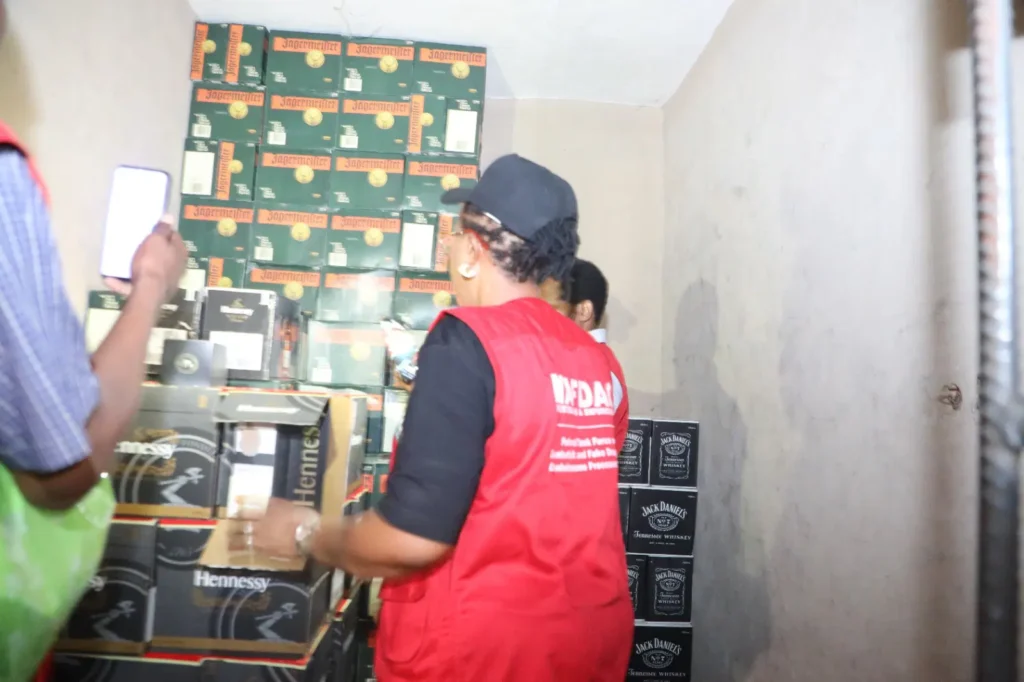
The suspects, identified as Chibuzor Okafor and William John, were arrested during the enforcement operation. NAFDAC said the raid followed intelligence reports and surveillance on suspected counterfeiters operating within the Trade Fair International Market.
Assistant Director of NAFDAC’s Investigation and Enforcement Directorate, Kunle Ojo, said officials caught some suspects allegedly producing alcoholic drinks during the operation. Items recovered included drums, filters, packaging materials, a heating device and other equipment.
“What we have discovered today is a lot, and it’s mind-boggling. We are here to protect the lives of many Nigerians,” Ojo said.
He explained that the agency had intensified enforcement ahead of the festive season. Demand for alcoholic beverages and other drinks typically rises during this period, increasing concerns about the circulation of counterfeit products.
NAFDAC Investigates Sources of Counterfeit Drinks
Ojo said the agency would investigate the origin of the recovered products and the raw materials used in their production. Investigators would also seek to identify individuals allegedly financing or directing the operation.
“Where are they getting the products from? Where are they getting their raw materials? Who is employing them to do this kind of dangerous activity?” he asked.
The official said NAFDAC would move the recovered products and materials to its warehouse for further action. He added that the agency would pursue appropriate administrative and legal procedures against those arrested.
“Those people that we have arrested today will be dealt with administratively and definitely will face the law,” Ojo said.
The operation reflects wider concerns about consumer safety and product regulation in Nigeria. Readers can also see NAFDAC’s Warning on Toxic Pesticides in Food and Seizure of ₦800m Chemicals for related public health coverage.
Suspect Explains Why He Changed Drink Bottles
One of the arrested suspects, Chibuzor Okafor, identified himself as a drinks dealer in the market. Speaking to Vanguard at the scene, he said he transferred drinks into different bottles because he believed the original containers had become damaged.
“I deal in drinks. I change the bottle of the drink. It’s not that the bottle is not good. It’s the drink in there, because the other one is already damaged. So that’s why we are putting it in the next bottle,” he said.
NAFDAC has not established all the circumstances surrounding the alleged operation in the information provided. The agency said its investigation would examine the products, materials and people connected to the facility.
NAFDAC Says Enforcement Operations Are Ongoing
Deputy Director of NAFDAC Public Relations, Christiana Obiazikwor, said the agency regularly conducts surveillance, seizures, arrests and destruction of unregistered or counterfeit products. She said officials continue to work in markets and other locations despite public criticism of enforcement efforts
“NAFDAC is still at work. We are on the streets, in the markets and everywhere,” Obiazikwor said.
She explained that the agency often keeps enforcement operations out of the public eye to avoid alerting suspected offenders or provoking confrontations. However, officials invited journalists to observe the latest operation to demonstrate their work and reassure the public.
She urged Nigerians to report suspected counterfeit production and distribution directly to NAFDAC. According to her, social media posts alone may spread fear without helping investigators establish the facts.
“There’s no point going to social media to create fear. Report to NAFDAC, and we’ll do the needful,” she said.
Obiazikwor also assured informants that the agency would protect their identities.
NAFDAC Says Suspected Operators Changed Locations
Assistant Director and Head of Public Relations for Investigation and Enforcement, Victoria Jennifer Akudu, described the raid as part of NAFDAC’s routine enforcement activities. She said teams regularly visit locations to identify illegal manufacturing and distribution operations.
Akudu disclosed that the suspected operators had allegedly moved from an earlier location following enforcement action. Officials continued tracking their activities before reaching the facility at the Trade Fair Complex.
“We have confiscated and sealed off the place. They moved to another place. This time around, we passed through the back door. And that is how we are able to get them,” she said.
She urged Nigerians to avoid spreading unverified claims about suspected counterfeit products. Instead, she encouraged the public to report credible information directly to the agency.
“I will ask Nigerians not to fear. We are alert, and we are alive. We are doing our statutory function the way it should be,” Akudu said.
Agency Warns Against Counterfeit Drinks
NAFDAC said the operation forms part of its continuing efforts to remove counterfeit, adulterated and unregistered products from the Nigerian market. Officials warned that repackaging drinks under established brand labels without proper quality controls could expose consumers to serious health risks.
The agency said its investigation would help determine the origin of the products and identify other people who may have been involved. It also urged Nigerians to provide credible information that could support enforcement activities.
Consumers should remain cautious about drinks with suspicious packaging, unclear product information or questionable sources. However, suspected products should be reported to the relevant authorities rather than treated as confirmed counterfeits without verification.
The agency reiterated its commitment to protecting public health through inspections, seizures and enforcement against suspected illegal production and distribution.